Mobility Equipment Blog & Resources
Expert articles, clinical guides, and healthcare technology innovations from Anrace.
Wheelchairs & Rehab Guides
In-depth insights into power mobility, manual wheelchairs, and patient lift chairs.
Empowering Independent Living
Discover global trends and manufacturing advancements in assistive products.
2026 Best Foldable Rollaway Bed for Hotels?
Table of Contents
- What Defines a Foldable Rollaway Bed for Hotel Use in 2026?
- How Rollaway Bed Frames, Mattresses, and Folding Mechanisms Work
- Which Features Matter When Choosing a Hotel Rollaway Bed?
- How to Compare Rollaway Beds for Comfort, Durability, and Safety
- How Hotels Can Store, Maintain, and Replace Rollaway Beds
- FAQS
- Conclusion
- Related Posts
Choosing the 2026 best Foldable Rollaway Bed for hotels is not just a matter of comparing prices. Staff need a frame that unfolds smoothly, locks securely, and rolls across carpet without rattling. Guests need enough mattress support for a full night, not merely a quick nap. Small details matter. A loose hinge or thin mattress can turn a convenient extra bed into a complaint at checkout.
Hospitality leader Horst Schulze is known for the principle, “Ladies and gentlemen serving ladies and gentlemen.” It is a useful standard for evaluating guest-room equipment: practical design should make service easier while helping guests feel considered. For a hotel, that means checking the folded footprint, open-bed dimensions, mattress thickness, caster quality, frame material, and stated weight capacity. Test the setup in a real room, too. A bed that looks compact in a catalog may block a doorway or crowd a bedside table. Not every room fits. This guide compares the features that affect daily use, including storage, setup, durability, and comfort, while noting where product claims need closer inspection. No single model suits every property. The right choice depends on room layouts, staff routines, and how often the bed will be used.
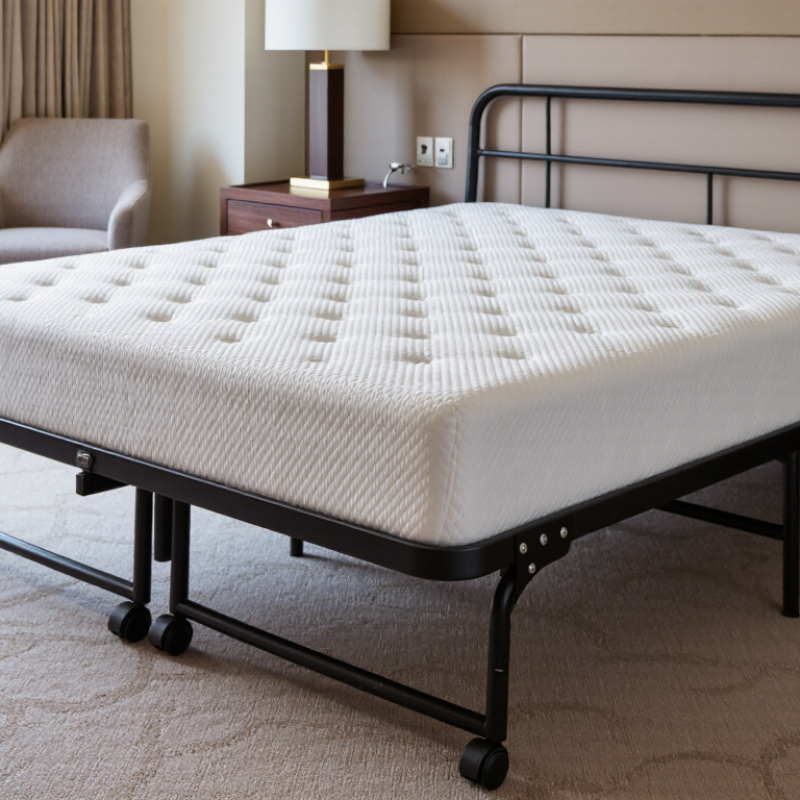
What Defines a Foldable Rollaway Bed for Hotel Use in 2026?
What defines a foldable rollaway bed for hotel use in 2026? It is more than a frame that folds flat. Staff need to move it through a doorway, lock it securely, and prepare it without wrestling with stiff hinges. AHLA’s 2024 State of the Industry report found that 76% of surveyed hotels faced staffing shortages. That makes simple setup and compact storage practical priorities. Test the bed in a real room: check door clearance, folded footprint, caster locks, and the frame’s stated weight capacity. Details matter.
Guest comfort and housekeeping matter too. Look for a supportive mattress, a removable or cleanable cover, smooth surfaces, and hinges that reduce pinch risks. J.D. Power’s 2024 North America Hotel Guest Satisfaction Index Study reported overall satisfaction of 701 out of 1,000. The study does not assess rollaway beds specifically, so that figure is context, not proof that one feature drives satisfaction. A quiet wheel can still matter at midnight. So can a bed that fits beside a suitcase. There is no universal room layout, and even a good checklist can miss a tight corner. Test the folded bed and the sleeping setup with your own rooms, linens, and cleaning routine before choosing.
How Rollaway Bed Frames, Mattresses, and Folding Mechanisms Work
A rollaway bed works as a linked system: the frame supports the sleeper, the mattress distributes pressure, and the hinges let the unit fold. Most frames use paired metal rails, crossbars, and a scissor-style linkage. When opened, locking braces should engage fully; otherwise, the frame may shift under movement. Small parts matter. Check joints, wheels, and locking pins for looseness before each setup.
Mattress fit is not cosmetic. Sleep Foundation’s mattress-size guide lists a standard U.S. twin at 38 by 75 inches, a useful reference when checking deck dimensions. A mattress that overhangs can catch during folding, while one that is too narrow may slide. Measure the usable deck, not just the outside rails. Foam bends more easily than a thick spring unit, but repeated folding can still strain its seams. Not perfectly simple.
The folding mechanism also determines how staff handle storage and room changes. Keep fingers clear of hinge points, fold on a level surface, and confirm the bed is locked before use. EN 1725:2023 covers bed safety, strength, and durability test methods; ask suppliers for applicable test documentation and stated weight limits. AHLA’s 2024 State of the Industry report projected U.S. hotel occupancy of 63.6% that year, underscoring the value of frames designed for frequent room use. Occupancy alone does not prove durability, though; inspection records matter.
2026 Best Foldable Rollaway Bed for Hotels? — Mattress Size Comparison
Standard mattress dimensions provide a useful starting point when checking rollaway bed fit.
Twin and Twin XL sizes are common reference points for compact guest beds. Rollaway frames may require nonstandard mattress dimensions, so confirm the frame’s specified mattress size before buying.
Which Features Matter When Choosing a Hotel Rollaway Bed?
Choosing a hotel rollaway bed means balancing guest comfort with daily handling. AHLA’s 2024 State of the American Hotel Industry report, prepared with Oxford Economics, projected U.S. hotel occupancy at 63.6%. That level of room use makes quick setup and reliable storage practical priorities. Staff should be able to unfold the frame without pinched fingers or awkward lifting. Test the locking mechanism, wheel brakes, and frame stability on the actual floor surface. Small details matter.
Check the open dimensions, mattress thickness, and stated weight capacity against the guests the hotel serves. A supportive mattress should not sag at the center, and the frame should stay quiet when someone turns. Ask suppliers for documented load testing and clear care instructions; vague claims are difficult to verify. A heavier frame may feel steadier, but it can slow room turnover. The trade-off is real.
Storage and cleaning deserve equal attention. Measure the folded unit beside the intended closet or service-area doorway, then check whether staff can move it safely. Smooth, accessible surfaces make routine wiping easier, while exposed joints can collect dust. Inspect sample units after repeated folding, not just straight from the box. One imperfect point: a compact design can still be cumbersome if its wheels catch on carpet. Include housekeeping staff in the trial, and record setup time, noise, and any loose fittings before ordering in quantity.
| 2026 Best Foldable Rollaway Bed for Hotels? - Which Features Matter When Choosing a Hotel Rollaway Bed? | |||
|---|---|---|---|
| Feature | Why It Matters for Hotels | Practical Selection Guidance | What to Verify Before Buying |
| Sleeping Size | A suitable mattress size helps accommodate guests comfortably and fit the room layout. | Many U.S. rollaway beds are designed around a Twin-size sleeping surface, approximately 38 × 75 in (97 × 191 cm). Actual dimensions vary by model. | Check the usable mattress dimensions, not just the frame dimensions, and confirm that the bed fits through doorways and into storage areas. |
| Mattress Comfort | Mattress construction and thickness affect support, comfort, and how the bed feels during an overnight stay. | Compare the mattress material, thickness, firmness, and support system. There is no single thickness that suits every guest or rollaway frame. | Ask for the mattress specifications and confirm whether replacement mattresses are available for the frame. |
| Published Weight Capacity | A clearly stated load rating helps staff select a bed appropriate for guests and use it within the manufacturer's limits. | Choose a model with a published capacity that meets the hotel’s requirements; ratings differ between products and should not be assumed from appearance alone. | Confirm the rated capacity, what the rating includes, and the manufacturer’s instructions for use. |
| Frame and Support | A sturdy frame and evenly spaced supports can help the bed remain stable under normal use and repeated setup. | Inspect the frame construction, joints, mattress platform, and support points. Prioritize a design that opens and closes securely. | Review assembly details, inspection guidance, warranty terms, and availability of replacement parts. |
| Folding and Setup | Quick, straightforward setup reduces staff handling time and helps prevent setup errors. | Look for a folding mechanism that staff can operate safely and consistently, with clear instructions and secure locking points. | Test opening, locking, folding, and storage with the staff who will handle the bed. |
| Casters and Brakes | Wheels make it easier to move a bed between rooms, while effective brakes help prevent unwanted movement when it is in use. | Check that the casters roll smoothly on the hotel’s floor surfaces and that the braking system is easy to engage. | Verify the number and position of locking casters, floor compatibility, and caster replacement options. |
| Folded Storage Footprint | Compact storage can make a significant difference in housekeeping areas and limited back-of-house space. | Compare the folded length, width, and height with the hotel’s available storage space. Dimensions vary by model. | Request the folded dimensions and check whether the bed can be stored upright or requires a specific orientation. |
| Cleaning and Maintenance | Easy-to-clean surfaces and accessible components support routine housekeeping and help staff spot wear. | Prefer frame finishes and mattress covers that can be maintained according to the supplier’s care instructions. | Confirm approved cleaning methods, inspection intervals, and procedures for damaged or worn parts. |
| Fire and Regulatory Requirements | Requirements for mattresses and furnishings can depend on the location, building, and intended use. | Do not assume a product meets every hotel’s local requirements based on a general product description. | Ask for relevant test documentation and have the hotel’s compliance team confirm applicable local codes and purchasing requirements. |
| Warranty and Parts Support | Reliable support can reduce downtime when a mattress, caster, or frame component needs attention. | Compare warranty coverage, exclusions, service response, and the expected availability of replacement parts. | Get warranty and parts information in writing and confirm the process for reporting a fault. |
How to Compare Rollaway Beds for Comfort, Durability, and Safety
2026 Best Foldable Rollaway Bed for Hotels?
How to Compare Rollaway Beds for Comfort, Durability, and Safety
A rollaway bed must feel steady, not merely fit inside a storage closet. The American Hotel & Lodging Association’s 2024 State of the Hotel Industry report projected U.S. hotel occupancy at 63.6%. That forecast points to frequent room turnover, so frames and hinges may face repeated handling. Check the open bed for wobble, uneven support, and wheels that move after the brakes are set. Small details matter.
For comfort, compare mattress thickness, support across the full sleeping surface, and the bed’s dimensions. Ask for mattress test results based on ASTM F1566, a standard covering mattress and foundation performance. It does not predict every guest’s comfort. A quick lie-down may reveal a firm edge or a bar felt through the mattress.
Durability claims need evidence. Request the frame’s rated load and documented tests for repeated folding, locking, and rolling. Inspect hinge connections, welds, wheel mounts, and exposed pinch points. Test the lock with the bed fully open; a latch that catches only sometimes is a concern. Specs can look reassuring on paper. Real rooms are less tidy.
How Hotels Can Store, Maintain, and Replace Rollaway Beds
2026 Best Foldable Rollaway Bed for Hotels?
A dependable rollaway bed is only useful when staff can store and maintain it properly. Choose a folding model that fits the hotel’s storage area, passes through service doors, and opens without forcing the frame. Before storing it, check that the mattress and frame are dry. Keep beds in a designated, ventilated space, secured against tipping and clear of cleaning equipment. A crowded storeroom can make even a good bed difficult to inspect.
Tips: Add a quick check to room-turnover procedures. Test the locking mechanism, roll each wheel, and look for loose fasteners, bent rails, torn fabric, or a mattress that no longer lies flat. Record defects and remove unsafe beds from service.
Replacement timing depends on use, not just age. A bed used nightly in a busy property will wear differently from one used occasionally. Track repairs, inspection dates, and recurring complaints so purchasing decisions rely on evidence. Replace a unit if its frame will not lock securely, wheels repeatedly fail, or the mattress remains uneven after proper care. Follow the manufacturer’s maintenance guidance, and train staff to report damage rather than improvise repairs. No checklist catches everything. Review the process after near misses or repeated service calls; some procedures look fine on paper but fail during a rushed room change.
FAQS
It folds easily, fits through service doors, and stores in a compact space. Test it in an actual room before choosing.
Check the locking mechanism, wheel brakes, frame stability, and hinge movement. Staff should unfold it without awkward lifting or pinched fingers.
Look for a supportive mattress that stays level and a frame that remains quiet when someone turns. A midnight squeak matters.
Compare the stated capacity with the guests the hotel serves. Ask for documented load testing, since vague claims are hard to verify.
Measure the open bed, folded footprint, and storage doorway. Check nearby space for luggage and room to move around.
Keep the mattress and frame dry in a ventilated, designated space. Secure beds against tipping and keep cleaning equipment clear.
Test the locks and wheels. Look for loose fasteners, bent rails, torn fabric, and an uneven mattress. Record defects.
Replace it if the frame will not lock securely, wheels repeatedly fail, or the mattress stays uneven after proper care. Age alone is not enough.
No checklist catches everything. Review procedures after near misses or repeated repairs; a process that looks fine on paper may fail during a rushed room change.
Conclusion
Choosing the best Foldable Rollaway Bed for a hotel in 2026 means balancing guest comfort, dependable construction, and efficient storage. A practical design typically combines a sturdy frame, a supportive mattress, and a folding mechanism that opens and closes smoothly. Hotels should consider mattress thickness and feel, frame stability, weight capacity, locking features, portability, and how easily staff can move the bed through guest rooms and corridors.
Comparing these beds requires looking beyond initial comfort: durable materials and secure joints can help them withstand frequent use, while reliable locks and stable legs support safer setup. Hotels should also plan where beds will be stored, inspect frames and mattresses regularly, clean them according to care guidance, and replace worn components when needed. A thoughtful choice can make extra sleeping space more comfortable for guests and simpler for staff to manage.

Blog Tags: